Showing posts with label 2014 A to Z Blog Challenge. Show all posts

Thursday, May 1, 2014

Alphabet Recollections 2014 - A to Z, In Brief

The 2014 A to Z Blog Challenge is Over. . . and I can claim another badge. My theme was ART - Artists, Art Trivia, Art Legends.


Thanks to all those new and ongoing visitors, commenters and new followers who happened by this blog during the Challenge! Kudos to the Co-host Teams, Lee at 'Tossing it Out', and the participants at the A to Z site, who kept the challenge alive and healthy! For a blogfest as big as this, the support from commenters is a major part of what makes it fun.

My takeaways from the 2014 A to Z Blog Challenge: 

-schedule posts
-research prior to April
-pace the visiting and working on own posts
-follow a series I like (or several)
-post early in the day

That's what works for me. I hope you had a good time. I did, but now I'm back to my usual blogging schedule, writing and tackling those books in the e-TBR, the tangible TBR, and my two wips.

***

UPDATE: Links list, top of page under the ART AtoZ tab
May 10/14

***
How about you? Had enough of daily posting? Are you taking a break? Or jumping back in?

Please leave a comment to let me know you were here, and thanks for dropping by. I'll respond.

***

Friday, April 4, 2014

D = Delacroix, Eugène - 2014 A to Z Blog Challenge

ART: Artists, Art Trivia, Art Legends

A glimpse of the ART world, in the manner of an alphabetical mini-art tour. ART focuses on my selection of the artists and the art style movements from the end of the 1800's and into the first half of the 1900's. There are exceptions, such as this one.


Eugène Delacroix, 1822, Early portrait, PD*-WC


D = Delacroix,  Eugène  
1798 - 1863

French painter Eugène Delacroix, regarded as the leader of the French Romantics, was the nemesis of Ingres**, according to sources.  Delacroix' s brushstrokes and optical effects of color had a major influence on the work of the Impressionists, while his passion for the exotic inspired the Symbolist artists. As a lithographer, he illustrated various selected works of William Shakespeare, Walter Scott, and Johann W. von Goethe.

Delacroix was inspired by the art of Rubens and the painters of the Venetian Renaissance. Drama and romantic content were his central themes. Delacroix's most influential work was Liberty Leading the People, a painting from 1830. The painting and what it depicted raised a few concerns.

** Ingres will appear as the A to Z artist on April 10th.
 

***


English: Liberty Leading the People, 1830

French: La Liberté guidant le people


Liberty Leading the People, Eugène Delacroix, Louvre,  PD*-WC


In the Romantic style painting above of the July 28, 1830, French Revolution (also called the July Revolution), we see a 'constructed' scene. Liberty, the allegorical goddess-figure is shown leading the charge. Some sources say the figure in the top hat on the left of the painting is Delacroix. Artist license? Perhaps, but knowing that it might be the artist adds interest. He was evoking contemporary events of his time by using the romantic image of the spirit of Liberty.

The French government purchased the painting in 1830, but deemed its glorification of liberty too inflammatory and removed it from public view. Note: we saw this painting in 2010 in the Louvre museum in Paris, its traditional home. Since 2012, however, this painting is on exhibit at another gallery in Lens, Pas-de-Calais, France.


***

Are you familiar with the work of Delacroix? What do you think of paintings that commemorate historical events? Do you care if they are accurate? Does artistic license allow the artist to indicate his own feelings on the matter?

Please let me know you were here in the comments. Thanks for dropping by!

***

Brought to you by the A to Z Blog Challenge 2014 Team and the originator: Lee of Tossing it Out. Click the A to Z list of participants and read on. Hope to see you again throughout the blogfest.


***

Image Credits

PD*-WC July Column and Eugène Delacroix  sketch:

This is a file from the Wikimedia Commons. Commons is a freely licensed media file repository.

This media file is in the public domain in the United States. This applies to U.S. works where the copyright has expired, often because its first publication occurred prior to January 1, 1923. See this page for further explanation.

This image might not be in the public domain outside of the United States; this especially applies in the countries and areas that do not apply the rule of the shorter term for US works, such as Canada, Mainland China (not Hong Kong or Macao), Germany, Mexico, and Switzerland. The creator and year of publication are essential information and must be provided. See Wikipedia:Public domain and Wikipedia:Copyrights for more details.

Image Credit

PD*-WC  Liberty Leading the People

This is a file from the Wikimedia Commons. Commons is a freely licensed media file repository. . . This file is in use by a Wikimedia project which requires the file to be completely unchanged, including updates, minor improvements, and error corrections.
 
***

****

Thursday, April 3, 2014

C = Cézanne, Paul - 2014 A to Z Blog Challenge

ART: Artists, Art Trivia, Art Legends

A glimpse of the ART world, in the manner of an alphabetical mini-art tour. ART focuses on my selection of the artists and the art style movements from the end of the 1800's and into the first half of the 1900's. There are exceptions.


Self-portrait, 1875, Musee d'Orsay, by P. Cézanne PD-WC*


C = Cézanne, Paul
1839–1906

Paul Cézanne was a French artist and Post-Impressionist painter. He was born in Aix-en-Provence, Provence, France. In Paris, circa 1852, Cézanne met and became friends with Émile Zola, and Camille Pissarro. In the mid 1860s the relationship was that of master Pissarro to disciple Cézanne, which allowed Pissarro's influence to help shape the younger artist.

Cézanne used geometrical shapes and optical illusions in his paintings, as well as the special effects of color. By experimenting with multiple views of the subject (as in stop-motion), the fracturing of the form itself began in a group composed of Picasso, Braque, Metzinger and Gris.


Post-Impressionist:

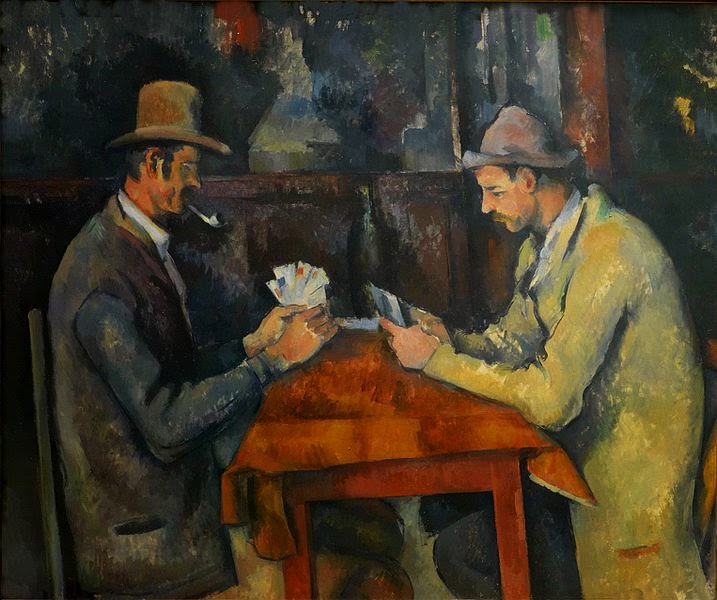
The Card Players, P. Cezanne, c.1892, PD*-WC


Cézanne's style became the impetus of the Cubism movement and inspired many Post-Impressionists. Both Matisse and Picasso are said to have considered Cézanne as a father figure. In Cubism, objects are broken up, analyzed and reassembled in abstracted form. The object is depicted in a multitude of viewpoints to represent the subject in greater context. The simpler the composition, the easier to see the main object.
 
***

Are you a fan of Cézanne's painting? Have you seen his still life paintings? What do you think of the painting shown above, The Card Players?

Please leave a comment to let me know you were here, and thanks for dropping by! I will respond.

****

Brought to you by the A to Z Blog Challenge 2014 Team and the originator: Lee of Tossing it Out! Click the A to Z list of participants and read on. Hope to see you again throughout the blogfest.


***
References:

http://www.paul-cezanne.org/  Paintings by Paul Cézanne

http://en.wikipedia.org/wiki/Paul_C%C3%A9zanne Paul Cézanne Wiki

***

* Image Credits for paintings:

Paul Cézanne Portrait, PD-WC

This work is in the public domain in the United States, and those countries with a copyright term of life of the author plus 100 years or less. This file has been identified as being free of known restrictions under copyright law, including all related and neighboring rights.

The work of art depicted in this image and the reproduction thereof are in the public domain worldwide. The reproduction is part of a collection of reproductions compiled by The Yorck Project. The compilation copyright is held by Zenodot Verlagsgesellschaft mbH and licensed under the GNU Free Documentation License


The Card Players - Image Credit:
PD-WC
This is a faithful photographic reproduction of a two-dimensional, public domain work of art. The work of art itself is in the public domain for the following reason: This work is in the public domain in the United States, and those countries with a copyright term of life of the author plus 100 years or less.
This file has been identified as being free of known restrictions under copyright law, including all related and neighboring rights.

***