Showing posts with label Cubism. Show all posts

Friday, April 18, 2014

P = Pablo Picasso, Art Legend - A to Z Challenge

ART: Artists, Art Trivia, Art Legends

A glimpse of the ART world, in the manner of an alphabetical mini-art tour. ART focuses on artists and art movements between the 1850's-1960's. There are exceptions.


Pablo Picasso 1962, via Wikipedia Commons (PD)

P = Pablo Picasso
1881 – 1973


As one of the most influential artists of the 20th century, Pablo Picasso is known as a co-founder of the Cubist movement, and the invention of constructed sculpture.

His career as a painter started in 1894. At the age of 14, he painted Portrait of Aunt Pepa, a portrait that is considered 'one of the greatest in the history of Spanish painting'. The influence of artists such as Toulouse-Lautrec and Edvard Munch led Pablo to form his own personal version of Modernism.

Picasso's most famous work is Guernica, his depiction of the bombing during the Spanish Civil War.

Guernica by Pablo Picasso, 1937.

http://en.wikipedia.org/wiki/File:PicassoGuernica.jpg  Guernica, scroll to bottom end of Wikipedia page.

Portrait of Igor Stravinsky, c. 1920
http://en.wikipedia.org/wiki/File:Stravinsky_picasso.png - also at the bottom of the wiki page


Picasso was exceptionally prolific throughout his long lifetime. The total number of artworks he produced has been estimated at 50,000, comprising 1,885 paintings; 1,228 sculptures; 2,880 ceramics, roughly 12,000 drawings, many thousands of prints, and numerous tapestries and rugs. 

Pablo died on April 8,1973 in Mougins, France. At the time of his death many of his paintings were in his possession. These works form the core of an immense collection of the Musée Picasso in Paris. (The Musée Picasso was closed for renovations when we located it in 2010 Paris.)
 
***

Are you a fan of Picasso's art? (early periods, cubism or sculpture)  Do you prefer some of his earlier 'realistic' paintings to the analytical cubism?

***

Brought to you by the A to Z Blog Challenge 2014 Team and the originator: Lee of Tossing it Out. Click the A to Z list of participants and read on.


***
References:
 

A Picasso Wiki
http://en.wikipedia.org/wiki/Pablo_Picasso 


Picasso - previous post in 2012 A to Z, Pablo's early time in Paris

http://dghudson-rainwriting.blogspot.ca/2012/04/p-pablo-picasso-in-paris-to-z-challenge.html


Pablo Picasso's works will not enter the public domain in France, Spain and other European countries until 2043.

Image of Picasso, 1962 -PD-WC

This image is in the public domain because the copyright of this photograph, registered in Argentina, has expired. (Both at least 25 years have passed after the photograph was created, and it was first published at least 20 years ago, Law 11.723, Article 34 as amended, and Berne Convention Article 7 (4)).

***

Thursday, April 3, 2014

C = Cézanne, Paul - 2014 A to Z Blog Challenge

ART: Artists, Art Trivia, Art Legends

A glimpse of the ART world, in the manner of an alphabetical mini-art tour. ART focuses on my selection of the artists and the art style movements from the end of the 1800's and into the first half of the 1900's. There are exceptions.


Self-portrait, 1875, Musee d'Orsay, by P. Cézanne PD-WC*


C = Cézanne, Paul
1839–1906

Paul Cézanne was a French artist and Post-Impressionist painter. He was born in Aix-en-Provence, Provence, France. In Paris, circa 1852, Cézanne met and became friends with Émile Zola, and Camille Pissarro. In the mid 1860s the relationship was that of master Pissarro to disciple Cézanne, which allowed Pissarro's influence to help shape the younger artist.

Cézanne used geometrical shapes and optical illusions in his paintings, as well as the special effects of color. By experimenting with multiple views of the subject (as in stop-motion), the fracturing of the form itself began in a group composed of Picasso, Braque, Metzinger and Gris.


Post-Impressionist:

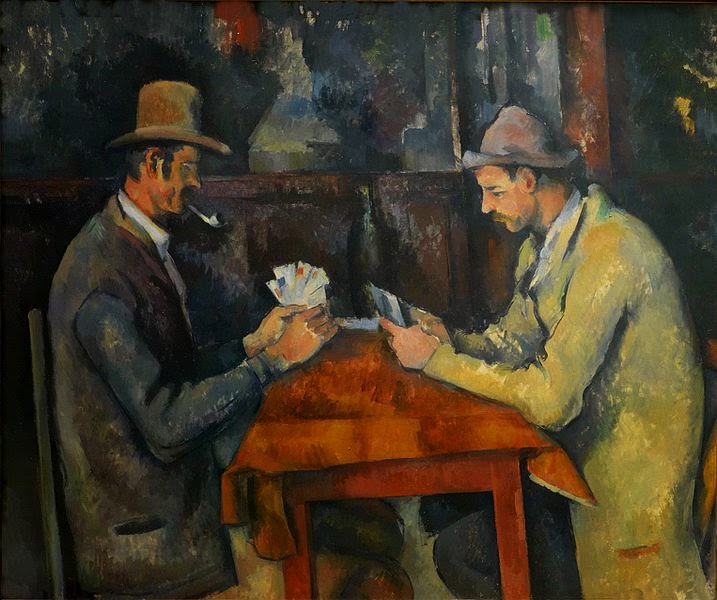
The Card Players, P. Cezanne, c.1892, PD*-WC


Cézanne's style became the impetus of the Cubism movement and inspired many Post-Impressionists. Both Matisse and Picasso are said to have considered Cézanne as a father figure. In Cubism, objects are broken up, analyzed and reassembled in abstracted form. The object is depicted in a multitude of viewpoints to represent the subject in greater context. The simpler the composition, the easier to see the main object.
 
***

Are you a fan of Cézanne's painting? Have you seen his still life paintings? What do you think of the painting shown above, The Card Players?

Please leave a comment to let me know you were here, and thanks for dropping by! I will respond.

****

Brought to you by the A to Z Blog Challenge 2014 Team and the originator: Lee of Tossing it Out! Click the A to Z list of participants and read on. Hope to see you again throughout the blogfest.


***
References:

http://www.paul-cezanne.org/  Paintings by Paul Cézanne

http://en.wikipedia.org/wiki/Paul_C%C3%A9zanne Paul Cézanne Wiki

***

* Image Credits for paintings:

Paul Cézanne Portrait, PD-WC

This work is in the public domain in the United States, and those countries with a copyright term of life of the author plus 100 years or less. This file has been identified as being free of known restrictions under copyright law, including all related and neighboring rights.

The work of art depicted in this image and the reproduction thereof are in the public domain worldwide. The reproduction is part of a collection of reproductions compiled by The Yorck Project. The compilation copyright is held by Zenodot Verlagsgesellschaft mbH and licensed under the GNU Free Documentation License


The Card Players - Image Credit:
PD-WC
This is a faithful photographic reproduction of a two-dimensional, public domain work of art. The work of art itself is in the public domain for the following reason: This work is in the public domain in the United States, and those countries with a copyright term of life of the author plus 100 years or less.
This file has been identified as being free of known restrictions under copyright law, including all related and neighboring rights.

***

Wednesday, April 2, 2014

B = Braque, Georges, 2014 A to Z Blog Challenge

ART: Artists, Art Trivia, Art Legends

A glimpse of the ART world, in the manner of a mini-art tour. ART focuses on the artists and the art style movements following Impressionism between the 1850s-1960s. There are exceptions.


Georges Braque, c.1908, Artist, PD*-WC


B = Braque, Georges
1882 – 1963

Georges Braque, French painter, collagist, draughtsman, printmaker and sculptor, was a major artist of the early 20th century. He was born in Argenteuil, Val-d'Oise, and grew up in Le Havre, France. Like his father and grandfather, Georges trained as a house painter and decorator. That changed when he arrived in Paris. In a city dedicated to art, he discovered new ways to paint.

Braque's contributions to Fauvism from 1906 onwards, and his part in the new art movement called Cubism, ensured his work would be remembered. Braque was part of the collective of artists in Paris at the turn of the century.

Frank G. Burgess, an artist, art critic, poet and author in the San Francisco Bay area, wrote an influential article titled, The Wild Men of Paris.  Burgess introduced the Proto-cubists to the United States including Braque, Pablo Picasso, Henri Matisse, and Jean Metzinger. Proto-cubism was the experimental stage of the art movement that would become Cubism.

***

Have you heard of the artist, Braque? Have you seen Cubist style painting or sculpture?

Unfortunately, most of Braque's paintings are not in the public domain until 2034, so I've included a link to one example.

Man With a Guitar 1914 - painting


Please leave a comment to let me know you were here! I'll respond. Thanks for dropping by.

***

Brought to you by the A to Z Blog Challenge 2014 Team and the originator: Lee of Tossing it Out. Click the A to Z list of participants and read on. Hope to see you again throughout the blogfest.


A to Z Blog Challenge, April 2014


***
References:

George Braque Wiki
http://en.wikipedia.org/wiki/Georges_Braque

***

*Image credit for photo of Braque, PD-WC

Georges Braque, 1908, photograph published in Gelett Burgess, The Wild Men of Paris, Architectural Record, May 1910

This image (or other media file) is in the public domain because its copyright has expired.
This applies to Australia, the European Union and those countries with a copyright term of life of the author plus 70 years.

You must also include a United States public domain tag to indicate why this work is in the public domain in the United States. Note that a few countries have copyright terms longer than 70 years: Mexico has 100 years, Colombia has 80 years, and Guatemala and Samoa have 75 years, Russia has 74 years for some authors. This image may not be in the public domain in these countries, which moreover do not implement the rule of the shorter term. Côte d'Ivoire has a general copyright term of 99 years and Honduras has 75 years, but they do implement the rule of the shorter term ***