Showing posts with label post-impressionists. Show all posts

Wednesday, April 22, 2015

S = Seurat, Georges-Pierre - Artist, French Faves - A to Z Challenge

An Artist who was point-on in his painting of an era. . .


A Sunday Afternoon on the Island of La Grande Jatte - WC*  by Georges-Pierre Seurat

S = Seurat, Georges-Pierre


Born December 2, 1859 - March 1891, George-Pierre Seurat was a French Post-Impressionist painter and a draftsman. He is known for his innovative use of drawing media and for devising the painting techniques known as Chromoluminarism
and Pointillism.


His large scale work, A Sunday Afternoon on the Island of La Grande Jatte, was painted between 1884 - 1886. This painting altered the direction of modern art by initiating Neo-impressionism. It is one of the icons of late 19th Century painting.


Artist Georges Seurat (1859-1891) WC*PD

In 1878, he moved on the Ecole des Beaux-Arts but his formal artistic education came to an end in November 1879, when he left to serve a year of military service.  Seurat's first exhibited work, at the Salon of 1883, was a Conte' crayon drawing of Aman-Jean. 

Georges-Pierre also studied the works of Eugene Delacroix, and his use of colour. He departed from the Impressionist style by preparing for the work with a number of drawings and sketches, before starting on the canvas. Impressionists preferred to work 'in the moment' creating their paintings in the field all in one session, without sketches or previous studies of the subject.


***


Cirque
English: The Circus

Georges Seurat,  Le Cirque, WC-PD *


Disillusioned, Seurat and some of the other artists he had met set up a new organization, the Societe des Artistes Independants. His ideas on pointillism influenced his fellow painters, Charles Angrand, Henri-Edmond Cross, Albert Dubois-Pillet and especially Paul Signac.

So, it seems there were Indies in art at the end of the 19th Century, just as there are in writing.

***

Have you heard of Seurat? Do you like the pointillism style? 


Please leave a comment to let me know you stopped by, and if you are part of the A to Z Challenge. I'll be sure to check your blog, and reciprocate. If you're not in the challenge, thanks for stopping by to visit! I try to reply to all comments.

***

The A to Z Blog Challenge is brainchild of Lee, at Tossing It Out.  Please visit the A to Z blog site to find out more information and the participant list.  There are also Twitter and Facebook presences if you want to check those!


***

References and Image Credits:

Georges Seurat Wiki
http://commons.wikimedia.org/wiki/File:Georges_Seurat_019.jpg

***
Portrait of Georges Seurat
This image (or other media file) is in the public domain because its copyright has expired.

This applies to Australia, the European Union and those countries with a copyright term of life of the author plus 70 years

***

A Sunday Afternoon on the Island of La Grande Jatte  by Georges-Pierre Seurat, Wikipedia Commons

This is a faithful photographic reproduction of a two-dimensional, public domain work of art.
This work is in the public domain in the United States, and those countries with a copyright term of life of the author plus 100 years or less.

***


Cirque


This work is in the 
public domain in the United States, and those countries with a copyright term of life of the author plus 100 years or less.The work of art depicted in this image and the reproduction thereof are in the public domain worldwide

***

Friday, April 25, 2014

V = Van Gogh, Vincent, A Complex Man - A to Z Challenge

ART: Artists, Art Trivia, Art Legends

ART focuses on artists and art movements between the 1850's-1960's. An artist of unusual vision is featured today, Vincent van Gogh, who saw movement in his surroundings and a particulate world, full of energy. 


Self Portrait with felt Hat, Vincent Van Gogh, c. 1880s


V = Vincent van Gogh
1853 - 1890


Vincent Willem van Gogh was a post-Impressionist painter of Dutch origin. He came to Paris in March of 1886 to share a Rue Laval apartment in Montmartre with his brother and to study at a local studio. In June, they moved to a larger apartment further uphill at 54 Rue Lepic. This address still exists today and has a small plaque on the building near the front door advising that Vincent and Leo once lived here. In Paris, Vincent painted views of Moulin de la Galette, Montmartre scenes, and locations by the Seine River.


Cafe Terrace at Night, 1888 by Van Gogh

Van Gogh didn't begin painting until his late twenties, completing many of his best works during the last couple of years of his life.  In just over ten years, he produced more than 2,100 art works which included 860 oil paintings, 1300 + watercolors, drawings, sketches and prints. There are self-portraits, landscapes, still life paintings , portraits, and paintings of wheat fields and sunflowers. Especially sunflowers. See the painting below by Gauguin showing Van Gogh at work.

After living in Paris for a few years, Vincent moved to the south of France where his work was influenced by the strong sunlight of the region. His palette of colors grew brighter and he developed the style that became his signature, during his stay in Arles in 1888.

After years of painful anxiety and frequent bouts of mental illness, Vincent died at age 37 from a gunshot wound, likely self-inflicted and accepted as such.  However, no gun was ever found. At that time, his work was known only to a select group of people.

*** 

The most comprehensive source of information about van Gogh is a collection of letters between him and his younger brother, Theo van Gogh, an art dealer. There were hundreds of letters between 1872 and 1890, with most of the letters sent from Vincent to Theo. He and his brother remained friends throughout their lives.

If you'd like to read more, try the novel, Dear Theo, by Irving Stone. The following in a part from the book description: "Van Gogh's brother Theo was his confidant and companion, and, in his letters to him, van Gogh reveals himself as artist and man. . ."

***

Painting sunflowers, Vincent is subject matter for his friend Gauguin. This is prior to their disagreement in Arles, France.


Van Gogh Painting Sunflowers by Paul Gauguin

***

Are you a fan of Van Gogh's art? Did you know about the missing ear (or part of it) and the story behind it? Do you have a favorite of Van Gogh's painting?

***

Brought to you by the A to Z Blog Challenge 2014 Team and the originator: Lee of Tossing it Out. Click the A to Z list of participants and read on. Hope to see you again throughout the blogfest.


 ***
References:

http://en.wikipedia.org/wiki/Vincent_van_Gogh Wiki on Vincent van Gogh

Article by Henry Samuel in Paris  04 May 2009; Another version of what happened to Vincent's ear. (UK Newspaper)

***

Image Credits

Cafe Terrace at Night, 1888 by Van Gogh

This work is in the public domain in the United States, and those countries with a copyright term of life of the author plus 100 years or less

The work of art depicted in this image and the reproduction thereof are in the public domain worldwide. The reproduction is part of a collection of reproductions compiled by The Yorck Project. The compilation copyright is held by Zenodot Verlagsgesellschaft mbH and licensed under the GNU Free Documentation License


***
Self Portrait of the Artist by Van Gogh

This work is in the public domain in the United States, and those countries with a copyright term of life of the author plus 100 years or less.

 The official position taken by the Wikimedia Foundation is that "faithful reproductions of two-dimensional public domain works of art are public domain".
This photographic reproduction is therefore also considered to be in the public domain

****
Vincent Van Gogh by Paul Gauguin

The work of art depicted in this image and the reproduction thereof are in the public domain worldwide. The reproduction is part of a collection of reproductions compiled by The Yorck Project. The compilation copyright is held by Zenodot Verlagsgesellschaft mbH and licensed under the GNU Free Documentation License.

***

Tuesday, April 8, 2014

G = Gauguin, Paul, Artist - A to Z Blog Challenge

ART: Artists, Art Trivia, Art Legends

A glimpse of the ART world, in the manner of an alphabetical mini-art tour. ART focuses on  artists and the art style movements from 1850's-1960's. There are exceptions.


Paul Gauguin, 1891, French Painter, PD*-WC

G = Gauguin, Paul 
1848 –1903

Eugène Henri Paul Gauguin was a leading French Post-Impressionist artist. His work was influential to Pablo Picasso and Henri Matisse.  He was a painter, sculptor, printmaker, ceramist and writer.He was also an important figure in the Symbolist movement.

Picasso's paintings in 1906 were influenced by Gauguin's sculpture, his painting and his writing. Later, it is said, Picasso played down Gauguin's influence. Another friendship that became rocky involved Vincent Van Gogh, during a 9-week painting trip in 1888, to the 'Yellow House in Arles'. There are two versions of the story of the 'severed ear' of Vincent. The regular version says the full ear suffered, but Gauguin's version said only the lower lobe of Vincent's ear was cut, which still bled enough to have Vincent hospitalized. Vincent didn't remember. Gauguin left Arles the next day. The two men never saw each other again.

Gauguin showed paintings in the Impressionist exhibitions in 1881 and 1882. Over two summer holidays, he painted with Camille Pissarro and sometimes Paul Cezanne.  In 1891, Gauguin sailed to French Polynesia to escape civilization. He made a few trips back to France before settling in the islands.


The Midday Nap, (1894)


The Midday Nap, 1894, Paul Gauguin, PD*-WC

 
At the end of his life, Gauguin made the mistake of siding with the natives against the French Colonialists. Sentenced to prison, he died May 8, 1903, before he could start serving his sentence. He died of an overdose of morphine and a possible heart attack. He was 54 years at the time. To read more, see links below.

*In 2014, an update has questioned whether Gauguin did indeed ever have syphilis, or have been treated for it. This was from DNA testing.  See: http://en.wikipedia.org/wiki/Paul_Gauguin under Later years and Death, for more details.

***

Brought to you by the A to Z Blog Challenge 2014 Team and the originator: Lee of Tossing it Out. Click the A to Z list of participants and read on. Hope to see you again throughout the blogfest!


***

http://en.wikipedia.org/wiki/Paul_Gauguin

Image Credit:

Photo of Gauguin, and Painting, Afternoon Nap or The Siesta

This work is in the public domain in the United States, and those countries with a copyright term of life of the author plus 100 years or less.

The work of art depicted in this image and the reproduction thereof are in the public domain worldwide. The reproduction is part of a collection of reproductions compiled by The Yorck Project. The compilation copyright is held by Zenodot Verlagsgesellschaft mbH and licensed under the GNU Free Documentation License.

Thursday, April 3, 2014

C = Cézanne, Paul - 2014 A to Z Blog Challenge

ART: Artists, Art Trivia, Art Legends

A glimpse of the ART world, in the manner of an alphabetical mini-art tour. ART focuses on my selection of the artists and the art style movements from the end of the 1800's and into the first half of the 1900's. There are exceptions.


Self-portrait, 1875, Musee d'Orsay, by P. Cézanne PD-WC*


C = Cézanne, Paul
1839–1906

Paul Cézanne was a French artist and Post-Impressionist painter. He was born in Aix-en-Provence, Provence, France. In Paris, circa 1852, Cézanne met and became friends with Émile Zola, and Camille Pissarro. In the mid 1860s the relationship was that of master Pissarro to disciple Cézanne, which allowed Pissarro's influence to help shape the younger artist.

Cézanne used geometrical shapes and optical illusions in his paintings, as well as the special effects of color. By experimenting with multiple views of the subject (as in stop-motion), the fracturing of the form itself began in a group composed of Picasso, Braque, Metzinger and Gris.


Post-Impressionist:

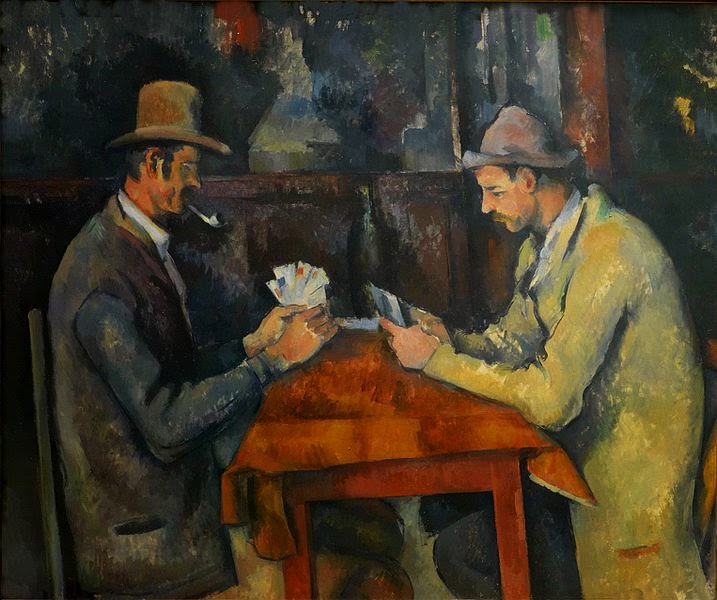
The Card Players, P. Cezanne, c.1892, PD*-WC


Cézanne's style became the impetus of the Cubism movement and inspired many Post-Impressionists. Both Matisse and Picasso are said to have considered Cézanne as a father figure. In Cubism, objects are broken up, analyzed and reassembled in abstracted form. The object is depicted in a multitude of viewpoints to represent the subject in greater context. The simpler the composition, the easier to see the main object.
 
***

Are you a fan of Cézanne's painting? Have you seen his still life paintings? What do you think of the painting shown above, The Card Players?

Please leave a comment to let me know you were here, and thanks for dropping by! I will respond.

****

Brought to you by the A to Z Blog Challenge 2014 Team and the originator: Lee of Tossing it Out! Click the A to Z list of participants and read on. Hope to see you again throughout the blogfest.


***
References:

http://www.paul-cezanne.org/  Paintings by Paul Cézanne

http://en.wikipedia.org/wiki/Paul_C%C3%A9zanne Paul Cézanne Wiki

***

* Image Credits for paintings:

Paul Cézanne Portrait, PD-WC

This work is in the public domain in the United States, and those countries with a copyright term of life of the author plus 100 years or less. This file has been identified as being free of known restrictions under copyright law, including all related and neighboring rights.

The work of art depicted in this image and the reproduction thereof are in the public domain worldwide. The reproduction is part of a collection of reproductions compiled by The Yorck Project. The compilation copyright is held by Zenodot Verlagsgesellschaft mbH and licensed under the GNU Free Documentation License


The Card Players - Image Credit:
PD-WC
This is a faithful photographic reproduction of a two-dimensional, public domain work of art. The work of art itself is in the public domain for the following reason: This work is in the public domain in the United States, and those countries with a copyright term of life of the author plus 100 years or less.
This file has been identified as being free of known restrictions under copyright law, including all related and neighboring rights.

***