Thursday, April 5, 2012

E = Eiffel Tower - A to Z Blog Challenge


Tour Eiffel Ironwork Detail - photo by Green Eye


Eiffel Tower and the Exposition Universelle


The Exposition Universelle of 1889 was a World's Fair held in Paris, France.  The fair coincided with the 100th anniversary of the storming of the Bastille, an event considered to be the trigger for the French Revolution.   It also introduced the Eiffel Tower to the world as it welcomed them to the exposition.


Originally positioned as the entrance arch to the World's Fair, the Eiffel Tower became a cultural icon of France and one of the most recognizable structures in the world. The tower is the tallest building in Paris and the most-visited paid monument in the world, per one source.


Eiffel Tower, looking across Champ de Mars by DG Hudson


In the photo above the Trocadero is shown under the arch of the tower supports (a classic shot).  You can't see the Eiffel Tower from every Parisian window, as movies would have us believe.   Only a few of the taller buildings have a clear view of the tower.  Zoning restrictions limit buildings over 7 stories in some arrondisements.  


***


Eiffel Tower Facts


From: '1980s' - Timeline section

"A restaurant and its supporting iron scaffolding midway up the tower was dismantled; it was purchased and reconstructed on St. Charles Avenue and Josephine Street in the Garden District of New Orleans, Louisiana, by entrepreneurs John Onorio and Daniel Bonnot, originally as the Tour Eiffel Restaurant, later as the Red Room and now as the Cricket Club (owned by the New Orleans Culinary Institute). The restaurant was re-assembled from 11,000 pieces that crossed the Atlantic in a 40-foot (12 m) cargo container."  See link below.


***


Paris, Eiffel Tower from Pont Alexander III by DG Hudson


***


Image copyright claims - Permissions


'The tower and its representations have long been in the public domain. However, a French court ruled, in June 1990, that a special lighting display on the tower in 1989, for the tower's 100th anniversary, was an "original visual creation" protected by copyright. As a result, it is no longer legal to publish contemporary photographs of the tower at night without permission in France and in some other countries."  Read more at the Eiffel Tower Wikipedia link below.

***

Did you learn anything new about the Eiffel Tower from this post?  Please share in the comments.


References:

http://www.youtube.com/watch?v=RnVb9JT7_mk&feature=related
Exposition Universelle de Paris 1889

http://en.wikipedia.org/wiki/Eiffel_Tower  Basic Info on the Eiffel Tower

http://dghudson.blogspot.ca/2012/03/eiffel-tower-paris-photo-study.html  More photos of the Eiffel Tower on this recent post on my 21st Century blog.

***

Wednesday, April 4, 2012

D = Dragons in Paris - A to Z Blog Challenge

 
Dragon detail, at the Louvre - by DG Hudson

Dragon at the Louvre

Frozen in stone, the small Dragon in the photo above will forever peer over his wing at what's following him. If this is only the detail, what did the rest of the building look like? Bits of antiquity make us wonder at the imaginations of the people in ages past. Dragons of various sorts have appeared in different cultures and continue to exist in myth and legend today.


***


Dragon at the Arc de Triomphe


Marianne with Dragon on Cap, Arc de Triomphe - by DG Hudson


A Dragon in the Louvre Museum surprised me, but so did the dragon sitting atop Marianne's cap on the bust halfway up the stairs of the Arc de Triomphe.  She's one of the warriors in the large sculptural groupings of the support columns.  Marianne  is a recognized yet informal symbol of France, and sometimes goes by other names.  I'm not sure whether the dragon is supposed to be symbolic or decorative, and couldn't find too many references to it.  Marianne is exhorting the people to fight for liberty, not sure about the dragon. 

***

There are two distinct cultural traditions of Dragons: the European dragon and the Chinese dragon. Within those two traditions are several sub-types, varying by country.  France has its own dragon style as do several other cultures. The two  featured in this post seem to be in line with the French type.


***

2012, the Year of the Dragon

The dragon sign of the Chinese Zodiac is the most powerful of the 12 signs, one associated with high energy and prosperity.  2012 is considered especially favorable because it's the year of the Water Dragon, something that happens once every 60 years.

***

DG's Theme:  Paris, Etc.  (Art, Film, Places and People)


Interested in dragons? Nasty and fiery or mind-meld types?  Born in the year of the Dragon?  Please share in the comments.

***

http://en.wikipedia.org/wiki/Chinese_zodiac Chinese Zodiak

http://www.cbc.ca/news/canada/story/2012/01/22/f-year-of-the-dragon.html
Year of the Dragon, CBC News

http://en.wikipedia.org/wiki/List_of_dragons_in_mythology_and_folklore List of mythological dragon types

http://en.wikipedia.org/wiki/Dragon Dragons

***

Tuesday, April 3, 2012

C = Carnavalet Museum - A-Z Blog Challenge


Courtyard and Garden, Carnavalet Museum, Paris - by Green Eye

The Carnavalet Museum is dedicated to preserving the history of Paris from the its beginning as the city of Lutetia through the Renaissance, the French Revolution, and into the twentieth century.  The Carnavalet Museum is located at 23 Rue de Sévigné, Paris, in the Marais, 4th Arrondisement.


In the courtyard, a courtly sculpture of Louis XIV, the Sun King, greets the visitor.  Manicured formal gardens on a city scale surround the walkways.  Netting covers the top portion of the building to protect the sculptures and the area below.


Louis XIV, the Sun King, Carnavalet Museum by DG Hudson
 ****

The museum occupies two neighboring mansions, the Hôtel Carnavalet, built in 1548, and the former Hôtel Le Peletier de Saint Fargeau.  (Hôtel = House or Residence)

Below is shown a bust of Camille Desmoulins (March 2, 1760 – April 5, 1794), an associate of M. Robespierre, of revolutionary fame. 


Camille Desmoulins in Musee Carnavalet, Paris by DG Hudson

Walking through the museum, I was reminded of the upheavals that took  place during the French Revolution.  It was a dangerous time to be in France.

Certain rooms in the Carnavalet Museum have an intimate feel due to the lighting, which protects antique documents and fabrics in display cases.  The rooms retain the decoration of the period, with strong jewel colours and gilding.  Chandeliers have replaced candlelight.

Commercial signage hangs near the entranceway, metal custom signs that indicated your type of business.  Small models show an aerial view of Paris in the 1700s.  Below is a model of the Bastille before its demise on July 14, 1789.


La Bastille Model -fortress, arsenal and prison, by DG Hudson


The Carnavalet Museum is near the trendy rue des Francs-Bourgeois and Place des Vosges, a great meeting place if you need a break from the walking.  There are other museums in the area tucked in neatly along the older two-lane streets in the Marais.  We visited on the weekend, when lots of people comb these side streets.

***

Links:

http://en.wikipedia.org/wiki/Carnavalet_Museum

http://www.parisdigest.com/museums/museecarnavalet.htm

http://www.britannica.com/EBchecked/topic/219315/French-Revolution

***

Photos taken in Paris, France by DG Hudson unless otherwise noted.  The Carnavalet Museum can be found on one of the side streets in the Marais.
****
Comments are welcome. Do you like history?  Domestic or world?

Monday, April 2, 2012

B = Bridges of Paris - A to Z Blog Challenge

Seine River Bridges at Dusk from Eiffel Tower - by DG Hudson


Bridges in Paris cross the Seine River some 37 times if you count pedestrian, rail and auto traffic bridges. Each is unique in design, size, and age, but all connect the two sides of Paris, the Right and Left Banks of the river.  A few connect the two main islands in the Seine, the Île de la Cité and the Île Saint-Louis and one or two have rail lines. 

Paris bridges seem to draw visitors to the Seine River, especially the Pont Neuf, the Pont D’Iena and the Pont Alexander III.   (A pont = bridge)


Grotesques line the overhang on the Pont Neuf, Paris  - by DG Hudson

Pont Neuf

It was the New Bridge when it was built in 1607.  Now, it's the oldest bridge.  It was the first stone bridge in Paris that did not support houses in addition to a thoroughfare, and it had curved bastions* so pedestrians could step aside to let a carriage pass. The decision not to include houses on the bridge can be traced back directly to Henry IV, who didn't want to impede his view of the Louvre. The bridge connects the left bank with the right bank over the western tip of the Île de la Cité.

*Bastions on the bridge deck are the curved places shown above. You can just see the small grotesques lining the edge.


Detail on Pont Alexander III - Paris, by DG Hudson


Pont Alexandre III

The most sumptuous bridge of Paris opened just in time for the Universal Exposition of 1900. It is named after Tsar Alexander III of Russia. The bridge is decorated with lampposts and sculptures of cherubs and nymphs. Tall pillars on either side of the bridge are topped with large gilded statues.


Under the Eiffel, Pont D'Iena, Paris - by DG Hudson

Pont d'Iéna


This bridge which leads from the Trocadéro to the Eiffel Tower, was built between 1808 and 1814. It was named after the German city of Jena (Iéna in French) where Napoléon had defeated the Prussian army in 1806.


***

A few other notables:


Pont Notre Dame


In Roman times, this was known as the Grand Pont (large bridge) and connected the Ile de la Cite' with the Right bank. The current bridge was originally built in 1853 with five small spans, but had to be redesigned in 1919 after many accidents. At that time, the middle three spans were replaced by a single span.


Pont Marie

Pont Marie, the next oldest bridge in Paris after the Pont Neuf, was built between 1614 and 1635.  The Pont Marie connects the Île St. Louis with the right bank of the Seine River.


Passerelle Simone de Beauvoir

A recently completed pedestrian bridge, the Passerelle Simone de Beauvoir leads from the Bibliotheque Nationale towards the Bercy Park.  Named after Simone de Beauvoir, a famous French author, philosopher, feminist, and companion of Jean-Paul Sartre.

***

This post shows a token number of the bridges that cross the Seine River in Paris.  I've included links for those that might want to know more.

***

DG's A to Z Challenge Theme:  Paris, Etc.   (Art, Film, People and Places)

***

References:
http://www.pariswater.com/ponts/  Paris Bridges

http://en.wikipedia.org/wiki/List_of_bridges_in_Paris   List of bridges in Paris

http://en.wikipedia.org/wiki/Seine  Seine River

http://www.aparisguide.com/seine/index.html  Seine River


***

Is there any special type of bridge that you like? (old wooden, wrought iron, suspension/cable design, or stone old-style)

Any writing memories associated with bridges?  Please share in the comments. 

***

Sunday, April 1, 2012

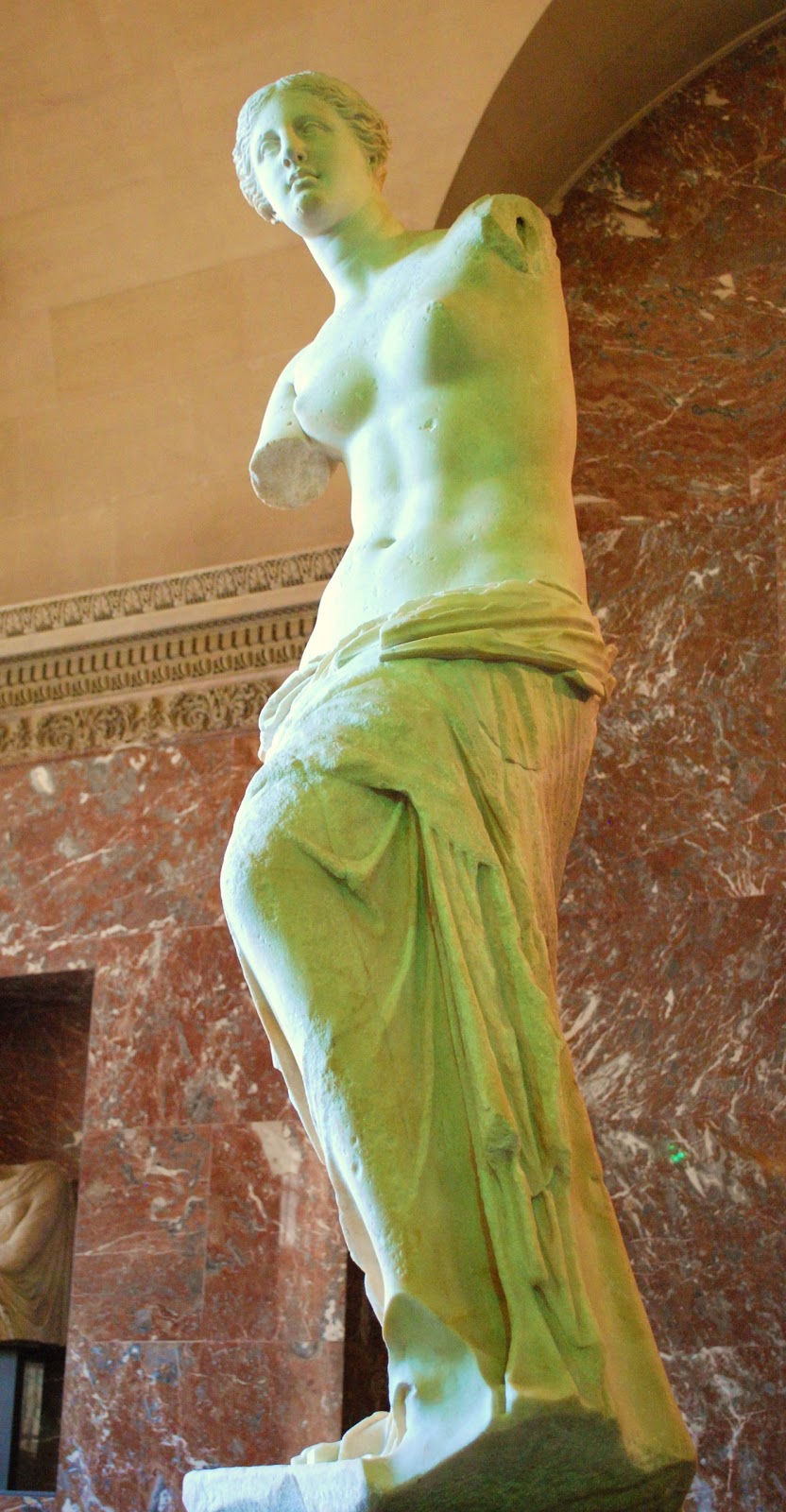
A = Aphrodite - A to Z Challenge 2012

  
Aphrodite at the Louvre, Paris - by DG Hudson


A = Aphrodite of Milos

DG's Theme: Paris, Etc (Art, Film, Places, People)
Also called the Venus de Milo statue, Aphrodite resides in the Louvre Museum in Paris, France.  She's the Greek goddess of love and beauty.

Aphrodite, as seen in the photo above, was found in 1820 on Milos (or Melos), one of the Aegean islands.  The arms and original plinth have been lost.  Aphrodite’s face and body style are seen as a combination of the Classic and Hellenistic styles. During World War II, Aphrodite sheltered in safety at a French chateau along with two other important art works from the Louvre.


The legend surrounding Aphrodite started about 3200 BC, when she was revered by the Phoenicians.  She's the Greek Goddess without the body armor.  Born of a dispute between father and son, Aphrodite emerges fully grown in a very unconventional way.  I won't go into details.  See the links below for more on mythology.

Aphrodite seemed to have her fingers in everything, including the affairs of men.  The age of heroes ended with Zeus deciding to put an end to his daughter Aphrodite's practise of mating gods with humans.  These are half-human, half-god mythical heroes, not Marvel or DC comic superheroes.  To teach her a lesson, Zeus caused Aphrodite to fall in love with a mortal man, and suffer the strife of bearing a mortal son. 


Did you know Aphrodite was such a meddler?  Perhaps she had good intentions.  Comments are welcome.


***

Links:

Aphrodite at the Louvre Museum
http://www.louvre.fr/en/oeuvre-notices/aphrodite-known-venus-de-milo

Venus de Milo/Aphrodite
http://en.wikipedia.org/wiki/Venus_de_Milo

http://en.wikipedia.org/wiki/Aphrodite

Aphrodite Legend
http://www.phoenician.org/aphrodite_legend.htm

Aphrodite Myths
http://www.theoi.com/Olympios/AphroditeMyths3.html#Aesop

***

Thursday, March 1, 2012

Statuary at the Louvre - A Study in Stone

Paris, France


Inner Courtyard and Entrance to the Louvre by DG Hudson


If you've never been to the Louvre Museum in Paris, this photo study will give you a peek inside at some of the works on display when we visited in Autumn 2010.  Known for acquiring a broad range of art works, the Louvre's collection encompasses paintings, artifacts and statuary. 


Antiquities, Louvre Museum, Paris, photo by DG Hudson

The Louvre Museum is welcoming, allowing the visitor room to walk, sit or browse, (after you buy your ticket).  All exhibits are well organized and many of the statuary are placed to allow viewing up close.  This museum is huge and requires lots of walking, up stairs, down stairs and around the corners.  Different wings of the building are dedicated to specific time periods or various civilizations. 


Below is a corner of the ceiling enhanced with gilding, painted images and deep windows.


Ceiling detail Louvre Museum, Paris by DG Hudson


Don't miss the floors in this beautiful gallery.  A palace first, the Louvre was built to house a king and the details of its structure attest to its past.  Murals cover the walls at the top of the a stairway, and a huge Sphinx sits in a corridor, just waiting to be admired. 


Original Palace Foundations of the Louvre -Photo by DG Hudson


Don't miss the basement of the Louvre where the foundations of the original palace can be seen.  They give a hint of the age of the building, while the model shows the medieval design. 


Model of early Louvre Palace, photo by DG Hudson


Below is one of the must-see statues at the Louvre, Winged Victory; I've cropped out all the visitors who were at its feet, but there were many admiring this sculpture.


The Nike of Samothrace, or Winged Victory c.190 BC - photo by DG Hudson


The woodwork and design of the ceiling in some of the gallery halls, the multilayering of marble on the statues, and the detail on some of the columns make it difficult to know where to look first.  It's definitely a feast for the eyes and the camera.


Near the entrance to the Louvre Antiquities, by DG Hudson


Statues of different sizes, and of different cultures are displayed in a very satisfying manner for the viewer.  Exhibits can vary as to how noisy or crowded they might be, as the tour guides lead their groups through.  There are quiet exhibits with students sitting and drawing the statues or studying the paintings.  It's nice to see that art students are still sent to the galleries to study the masters.


In Main Gallery, A man rests, by DG Hudson


The sunlight made a play of light and shadow on these ladies.  Hairdos don't seem to have really changed that much.

Statuary with hair and dress details, Louvre, Paris by DG Hudson

Some exhibits encompass an entire room, with artifacts of the same time period,  like a room in an old castle.  Note the floor in the photo below and the mantel to the right.


Antiquities, Louvre Museum, Paris by DG Hudson


Another partial sculpture below is slightly larger than life size.  The statue is carved with such finesse that the headdress seems touchable.  It's tucked into a niche in one of the main galleries.

Antiquities at the Louvre, Paris by DG Hudson

Walk slowly through this museum or you'll miss something.  Look up, then down, at the walls and along the aisles.  Art is literally everywhere in this unique gallery.  For more details, check

Louvre Museum Home Page http://www.louvre.fr/en  

The Louvre Museum
http://en.wikipedia.org/wiki/Mus%C3%A9e_du_Louvre


****
How about you?  Do you go to museum/galleries to see art or natural history, flight museums, car museums? 

Please share in the comments if you know of unique or interesting museums that you've seen. 

Tuesday, February 28, 2012

Catch Fire! Blog Party - CassaFire Feb 28, 2012


CassaFire is Here!


If you like Science Fiction, then you must have heard of author Alex J. Cavanaugh. He's the blog owner of the site by the same name.  Check out the Ninja Captain's blog at http://alexjcavanaugh.blogspot.com/


Today is the Catch Fire! Blog Party, celebrating the release of CassaFire by Alex J. Cavanaugh! The goal is to help CassaFire “catch fire” on the best seller charts and achieve the success of the first book, CassaStar.


There’s also a special package of prizes being given away at the author’s blog (copies of CassaFire, CassaStar, tote bag, mug, and bookmarks) as well as book giveaways during his two-week blog tour.  See Alex’s site for details: http://alexjcavanaugh.blogspot.com/


***
CassaFire by Alex J. Cavanaugh

CassaStar was just the beginning…

The Vindicarn War is a distant memory and Byron’s days of piloting Cosbolt fighters are over. He has kept the promise he made to his fallen mentor and friend - to probe space on an exploration vessel. Shuttle work is dull, but it’s a free and solitary existence. The senior officer is content with his life aboard the Rennather.

The detection of alien ruins sends the exploration ship to the distant planet of Tgren. If their scientists can decipher the language, they can unlock the secrets of this device. Is it a key to the Tgren’s civilization or a weapon of unimaginable power? Tensions mount as their new allies are suspicious of the Cassan’s technology and strange mental abilities.

To complicate matters, the Tgrens are showing signs of mental powers themselves; the strongest of which belongs to a pilot named Athee, a woman whose skills rival Byron’s unique abilities. Forced to train her mind and further develop her flying aptitude, he finds his patience strained. Add a reluctant friendship with a young scientist, and he feels invaded on every level. All Byron wanted was his privacy…


Available today! 
Science fiction - space opera/adventure

Print ISBN 978-0-9827139-4-5, $15.95, 6x9, Trade paperback, 240 pages
EBook ISBN 978-0-9827139-6-9, $4.99, available in all formats

***
You can visit the author’s site at http://alexjcavanaugh.blogspot.com/ 
OR - Order from these sites:

Barnes and Noble

Amazon

Amazon Kindle

Amazon for Canadians


***
CassaFire is the sequel to Cavanaugh’s first book, CassaStar, an Amazon Top Ten Best Seller:
“…calls to mind the youthful focus of Robert Heinlein’s early military sf, as well as the excitement of space opera epitomized by the many Star Wars novels. Fast-paced military action and a youthful protagonist make this a good choice for both young adult and adult fans of space wars.” - Library Journal
***

Alex's site has all the details for ordering CassaFire, but watch the trailer below if you want a peek first.


CASSAFIRE TRAILER
**********************************


Now go over to Alex's site and join the party!