Monday, April 7, 2014

F = FAUVISM and Marc Chagall - A to Z Blog Challenge

ART: Artists, Art Trivia, Art Legends

A glimpse of the ART world, in the manner of an alphabetical mini-art tour. ART focuses on artists and art movements between the 1850's-1960's. There are exceptions.


Marc Chagall, 1911, I and the Village, PD*-WC


F = Fauvism
les Fauves (Wild Beasts)


Fauvism is the style of les Fauves (the wild beasts), a loose group of early twentieth-century Modern artists who emphasized painterly qualities over the realistic values of Impressionism. Painters of this style were Marc Chagall, Henri Matisse and Andre Derain. The paintings of the Fauves included wild brush work and strident colors, while keeping the subject matter simplified or abstract.
 

***

F = Fauvist Marc Chagall
1887 - 1985


Marc Chagall, in Paris 1921, PD*-WC


Marc Zakharovich Chagall, a Belarussian-Russian-French artist, came to Paris in 1910, at a time when Cubism was the dominant style. In Paris, he learned the technique of gouache** which he used to paint scenes from his homeland. He was adept in many mediums: painting, book illustrations, stained glass cathedral windows, stage sets, ceramics, tapestries and fine art prints. 

Chagall's first recognition came not from the other painters, but from poets such as Blaise Cendrars and Guillaume Apollinaire. His work was linked to Cubism, Symbolism, Fauvism and Surrealism. The artist didn't want his work associated with any art movement; however, he considered his work a unique language of symbols.

As a stained glass artist, he acquired some important commissions. He designed and produced stained glass windows for the cathedrals of Reims and Metz, the windows for the UN, the Jerusalem Windows in Israel, and part of the ceiling painting at the Opera Garnier (aka the Paris Opera).

Chagall's last work was a commissioned piece of art for the Rehabilitation Institute of Chicago (for disabled people of the world). The painting part of the design was completed, but Chagall died in 1985, before the tapestry part was finished.

**Gouache - a method of painting in opaque pigments ground in water and thickened with a gluey substance.

***

Do you recognize the name Mark Chagall? Do you like this style of painting, with its intricate detail and otherworldly color? What do you think of Fauvism?

***

Brought to you by the A to Z Blog Challenge 2014 Team and the originator: Lee of Tossing it Out. Click the A to Z list of participants and read on. Hope to see you again throughout the blogfest.


***

References:

http://en.wikipedia.org/wiki/Marc_Chagall - Marc Chagall wiki -and art examples


http://en.wikipedia.org/wiki/Fauvism - Fauvism defined


 ***

Image Credits

Portrait of Marc Chagall

This image (or other media file) is in the public domain because its copyright has expired.
This applies to Australia, the European Union and those countries with a copyright term of life of the author plus 70 years
 
You must also include a United States public domain tag to indicate why this work is in the public domain in the United States. Note that a few countries have copyright terms longer than 70 years: Mexico has 100 years, Colombia has 80 years, and Guatemala and Samoa have 75 years, Russia has 74 years for some authors. This image may not be in the public domain in these countries, which moreover do not implement the rule of the shorter term. Côte d'Ivoire has a general copyright term of 99 years and Honduras has 75 years, but they do implement the rule of the shorter term

PD*-WC

Marc Chagall, 1911, I and the Village

This image can have no independent copyright as it is simply a faithful reproduction of an old, public domain, two-dimensional work of art published outside the U.S. before 1923.

This image is in the public domain in the United States. In most cases, this means that it was first published prior to January 1, 1923. Other jurisdictions may have other rules, and this image might not be in the public domain outside the United States. See Wikipedia:Public domain and Wikipedia:Copyrights for more details.
 

Saturday, April 5, 2014

E = Emily Carr - A to Z Blog Challenge 2014

ART: Artists, Art Trivia, Art Legends

A glimpse of the ART world, in the manner of an alphabetical mini-art tour. ART focuses on artists and art movements between the 1850's - 1960's. There are exceptions.


Emily Carr as a young woman, PD*-WC


E = Emily Carr
1871 - 1945

Emily was a Canadian artist and writer inspired by the First Nations people of the Pacific Northwest Coast. She was one of the first painters in Canada to adopt the modernist and Post-Impressionist style of painting she learned while studying in France. Her painting matured as she did, shifting from aboriginal work to landscapes, especially forest scenes.

She wrote about life in British Columbia before many others did. Emily was an strong advocate of preserving aboriginal history in British Columbia and lectured about the history we would lose if we didn't curate the artifacts.


Emily's Art Study in Paris

In 1910, Emily went to study at the Academie Colarossi in Paris. She met and studied with several Post-Impressionists and Fauvists while in France, then returned to British Columbia, Canada to exhibit her French paintings. For the early part of her life, Emily's painting was not given due recognition.

In 1898, Carr had made the first of several sketching and painting trips to aboriginal villages, including Ucluelet on the west coast of Vancouver Island, not far from Tofino, B.C. In 1912, Carr visited the Queen Charlotte Islands and the Skeena River. She documented the art of several tribes there: She painted a carved raven that later inspired her iconic Big Raven painting.


Emily Carr, Kitwancool, 1928, PD*-WC


Emily also wrote about her early life in Victoria, B.C. and kept journals of her life as a painter. I've read these three books: Klee Wyck, The Book of Small, Hundreds and Thousands. Two of Emily's closest friends were her editor, Ira Dilworth and the artist, Lawren Harris. Harris, a Canadian painter from Ontario, is best known as a member of the Group of Seven (artists).

Carr suffered several heart attacks between 1937 and 1942.  On March 2, 1945, she suffered a fatal attack at the James Bay Inn in Victoria, BC, her hometown. Klee Wyck, published in 1941 with the help of her close friend and editor, was awarded the Governor-General's Award for non-fiction the same year.  The Emily Carr University of Art and Design, in Vancouver, is named after this inspiring woman, artist and writer.

 
***

Have you heard of Emily Carr? Would you have traveled to the remote areas and to fishing villages in Victorian times as Emily did?

Please leave a comment to let me know you were here, and thanks for stopping by! I'll respond.

****

Brought to you by the A to Z Blog Challenge 2014 Team and the originator: Lee of Tossing it Out. Click the A to Z list of participants and read on. Hope to see you again throughout the blogfest.


***

References:

http://en.wikipedia.org/wiki/Emily_Carr Wiki on Emily Carr

https://www.emilycarr.com/about-emily-carr/ Emily Carr House and about the artist.

http://bcheritage.ca/emilycarrhomework/writing/byemily.htm Books by Emily Carr.

***

Image Credits - Images 1 and 2: photo of Emily Carr, and photo of painting, Kitwancool

This Canadian work is in the public domain in Canada because its copyright has expired due to one of the following:
1. it was subject to Crown copyright and was first published more than 50 years ago, or it was not subject to Crown copyright, and
2. it is a photograph that was created prior to January 1, 1949, or
3. the creator died more than 50 years ago.
 ***********************

This image (or other media file) is in the public domain because its copyright has expired.
This applies to Australia, the European Union and those countries with a copyright term of life of the author plus 70 years.

*********
You must also include a United States public domain tag to indicate why this work is in the public domain in the United States. Note that a few countries have copyright terms longer than 70 years: Mexico has 100 years, Colombia has 80 years, and Guatemala and Samoa have 75 years, Russia has 74 years for some authors. This image may not be in the public domain in these countries, which moreover do not implement the rule of the shorter term. Côte d'Ivoire has a general copyright term of 99 years and Honduras has 75 years, but they do implement the rule of the shorter term.

****

Friday, April 4, 2014

D = Delacroix, Eugène - 2014 A to Z Blog Challenge

ART: Artists, Art Trivia, Art Legends

A glimpse of the ART world, in the manner of an alphabetical mini-art tour. ART focuses on my selection of the artists and the art style movements from the end of the 1800's and into the first half of the 1900's. There are exceptions, such as this one.


Eugène Delacroix, 1822, Early portrait, PD*-WC


D = Delacroix,  Eugène  
1798 - 1863

French painter Eugène Delacroix, regarded as the leader of the French Romantics, was the nemesis of Ingres**, according to sources.  Delacroix' s brushstrokes and optical effects of color had a major influence on the work of the Impressionists, while his passion for the exotic inspired the Symbolist artists. As a lithographer, he illustrated various selected works of William Shakespeare, Walter Scott, and Johann W. von Goethe.

Delacroix was inspired by the art of Rubens and the painters of the Venetian Renaissance. Drama and romantic content were his central themes. Delacroix's most influential work was Liberty Leading the People, a painting from 1830. The painting and what it depicted raised a few concerns.

** Ingres will appear as the A to Z artist on April 10th.
 

***


English: Liberty Leading the People, 1830

French: La Liberté guidant le people


Liberty Leading the People, Eugène Delacroix, Louvre,  PD*-WC


In the Romantic style painting above of the July 28, 1830, French Revolution (also called the July Revolution), we see a 'constructed' scene. Liberty, the allegorical goddess-figure is shown leading the charge. Some sources say the figure in the top hat on the left of the painting is Delacroix. Artist license? Perhaps, but knowing that it might be the artist adds interest. He was evoking contemporary events of his time by using the romantic image of the spirit of Liberty.

The French government purchased the painting in 1830, but deemed its glorification of liberty too inflammatory and removed it from public view. Note: we saw this painting in 2010 in the Louvre museum in Paris, its traditional home. Since 2012, however, this painting is on exhibit at another gallery in Lens, Pas-de-Calais, France.


***

Are you familiar with the work of Delacroix? What do you think of paintings that commemorate historical events? Do you care if they are accurate? Does artistic license allow the artist to indicate his own feelings on the matter?

Please let me know you were here in the comments. Thanks for dropping by!

***

Brought to you by the A to Z Blog Challenge 2014 Team and the originator: Lee of Tossing it Out. Click the A to Z list of participants and read on. Hope to see you again throughout the blogfest.


***

Image Credits

PD*-WC July Column and Eugène Delacroix  sketch:

This is a file from the Wikimedia Commons. Commons is a freely licensed media file repository.

This media file is in the public domain in the United States. This applies to U.S. works where the copyright has expired, often because its first publication occurred prior to January 1, 1923. See this page for further explanation.

This image might not be in the public domain outside of the United States; this especially applies in the countries and areas that do not apply the rule of the shorter term for US works, such as Canada, Mainland China (not Hong Kong or Macao), Germany, Mexico, and Switzerland. The creator and year of publication are essential information and must be provided. See Wikipedia:Public domain and Wikipedia:Copyrights for more details.

Image Credit

PD*-WC  Liberty Leading the People

This is a file from the Wikimedia Commons. Commons is a freely licensed media file repository. . . This file is in use by a Wikimedia project which requires the file to be completely unchanged, including updates, minor improvements, and error corrections.
 
***

****

Thursday, April 3, 2014

C = Cézanne, Paul - 2014 A to Z Blog Challenge

ART: Artists, Art Trivia, Art Legends

A glimpse of the ART world, in the manner of an alphabetical mini-art tour. ART focuses on my selection of the artists and the art style movements from the end of the 1800's and into the first half of the 1900's. There are exceptions.


Self-portrait, 1875, Musee d'Orsay, by P. Cézanne PD-WC*


C = Cézanne, Paul
1839–1906

Paul Cézanne was a French artist and Post-Impressionist painter. He was born in Aix-en-Provence, Provence, France. In Paris, circa 1852, Cézanne met and became friends with Émile Zola, and Camille Pissarro. In the mid 1860s the relationship was that of master Pissarro to disciple Cézanne, which allowed Pissarro's influence to help shape the younger artist.

Cézanne used geometrical shapes and optical illusions in his paintings, as well as the special effects of color. By experimenting with multiple views of the subject (as in stop-motion), the fracturing of the form itself began in a group composed of Picasso, Braque, Metzinger and Gris.


Post-Impressionist:

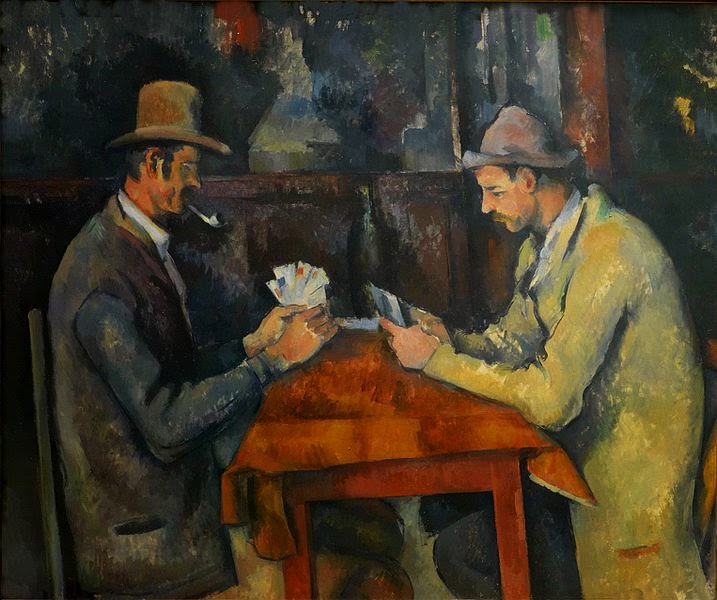
The Card Players, P. Cezanne, c.1892, PD*-WC


Cézanne's style became the impetus of the Cubism movement and inspired many Post-Impressionists. Both Matisse and Picasso are said to have considered Cézanne as a father figure. In Cubism, objects are broken up, analyzed and reassembled in abstracted form. The object is depicted in a multitude of viewpoints to represent the subject in greater context. The simpler the composition, the easier to see the main object.
 
***

Are you a fan of Cézanne's painting? Have you seen his still life paintings? What do you think of the painting shown above, The Card Players?

Please leave a comment to let me know you were here, and thanks for dropping by! I will respond.

****

Brought to you by the A to Z Blog Challenge 2014 Team and the originator: Lee of Tossing it Out! Click the A to Z list of participants and read on. Hope to see you again throughout the blogfest.


***
References:

http://www.paul-cezanne.org/  Paintings by Paul Cézanne

http://en.wikipedia.org/wiki/Paul_C%C3%A9zanne Paul Cézanne Wiki

***

* Image Credits for paintings:

Paul Cézanne Portrait, PD-WC

This work is in the public domain in the United States, and those countries with a copyright term of life of the author plus 100 years or less. This file has been identified as being free of known restrictions under copyright law, including all related and neighboring rights.

The work of art depicted in this image and the reproduction thereof are in the public domain worldwide. The reproduction is part of a collection of reproductions compiled by The Yorck Project. The compilation copyright is held by Zenodot Verlagsgesellschaft mbH and licensed under the GNU Free Documentation License


The Card Players - Image Credit:
PD-WC
This is a faithful photographic reproduction of a two-dimensional, public domain work of art. The work of art itself is in the public domain for the following reason: This work is in the public domain in the United States, and those countries with a copyright term of life of the author plus 100 years or less.
This file has been identified as being free of known restrictions under copyright law, including all related and neighboring rights.

***

Wednesday, April 2, 2014

B = Braque, Georges, 2014 A to Z Blog Challenge

ART: Artists, Art Trivia, Art Legends

A glimpse of the ART world, in the manner of a mini-art tour. ART focuses on the artists and the art style movements following Impressionism between the 1850s-1960s. There are exceptions.


Georges Braque, c.1908, Artist, PD*-WC


B = Braque, Georges
1882 – 1963

Georges Braque, French painter, collagist, draughtsman, printmaker and sculptor, was a major artist of the early 20th century. He was born in Argenteuil, Val-d'Oise, and grew up in Le Havre, France. Like his father and grandfather, Georges trained as a house painter and decorator. That changed when he arrived in Paris. In a city dedicated to art, he discovered new ways to paint.

Braque's contributions to Fauvism from 1906 onwards, and his part in the new art movement called Cubism, ensured his work would be remembered. Braque was part of the collective of artists in Paris at the turn of the century.

Frank G. Burgess, an artist, art critic, poet and author in the San Francisco Bay area, wrote an influential article titled, The Wild Men of Paris.  Burgess introduced the Proto-cubists to the United States including Braque, Pablo Picasso, Henri Matisse, and Jean Metzinger. Proto-cubism was the experimental stage of the art movement that would become Cubism.

***

Have you heard of the artist, Braque? Have you seen Cubist style painting or sculpture?

Unfortunately, most of Braque's paintings are not in the public domain until 2034, so I've included a link to one example.

Man With a Guitar 1914 - painting


Please leave a comment to let me know you were here! I'll respond. Thanks for dropping by.

***

Brought to you by the A to Z Blog Challenge 2014 Team and the originator: Lee of Tossing it Out. Click the A to Z list of participants and read on. Hope to see you again throughout the blogfest.


A to Z Blog Challenge, April 2014


***
References:

George Braque Wiki
http://en.wikipedia.org/wiki/Georges_Braque

***

*Image credit for photo of Braque, PD-WC

Georges Braque, 1908, photograph published in Gelett Burgess, The Wild Men of Paris, Architectural Record, May 1910

This image (or other media file) is in the public domain because its copyright has expired.
This applies to Australia, the European Union and those countries with a copyright term of life of the author plus 70 years.

You must also include a United States public domain tag to indicate why this work is in the public domain in the United States. Note that a few countries have copyright terms longer than 70 years: Mexico has 100 years, Colombia has 80 years, and Guatemala and Samoa have 75 years, Russia has 74 years for some authors. This image may not be in the public domain in these countries, which moreover do not implement the rule of the shorter term. Côte d'Ivoire has a general copyright term of 99 years and Honduras has 75 years, but they do implement the rule of the shorter term ***

Tuesday, April 1, 2014

A = Apollinaire, Guillaume - 2014 A to Z Blog Challenge

ART: Artists, Art Trivia, Art Legends

A glimpse of the ART world, in the manner of an alphabetical mini-art tour. ART focuses on my selection of the artists and the art style movements from the end of the 1800's and into the first half of the 1900's. There are a few exceptions.


G. Apollinaire, 1914, Art Critic, Poet, Writer - WC-PD*


A = Apollinaire, Guillaume
1880 –1918


Wilhelm Albert Wlodzimierz Apolinary Kostrowicki was born a Russian subject in Rome, and spoke French as well as several other languages. He emigrated to France in his teens and changed his name to Guillaume Apollinaire. As a French poet, playwright, short story writer, novelist, and art critic, he was in a prime position to become friends with many artists of the time.

An important poet of the early 20th century, he is considered one of the forefathers of surrealist plays. He is credited with coining the word 'surrealism' in the program notes for a ballet first performed on May 18, 1917. Active as a journalist, Apollinaire was an art critic for the Matin, Intransigeant, and Paris Journal.


Friend of Picasso

Apollinaire was arrested and jailed in September 1911 on suspicion of aiding and abetting the theft of the Mona Lisa, and a number of Egyptian statuettes from the Louvre. He was released a week later, but in the process he implicated his friend, Pablo Picasso. After questioning, Picasso was also exonerated. Vincenzo Peruggia, to whom Apollinaire gave shelter, had committed the thefts. Apollinaire also returned a number of stolen statuettes that were left behind by Peruggia.


Victim of the Flu Pandemic

Apollinaire fought in WWI until he suffered a serious shrapnel wound to the temple in 1916. He would never fully recover from this injury. During the Spanish flu pandemic of 1918, he died at the young age of 38. He is buried in Pere Lachaise Cemetery in Paris.

***

Have you ever heard of Apollinaire? Did you know of the thefts from the Louvre? Are you ready for this month of A to Z madness?

Please share in the comments, to let me know you were here. I'll respond. Thanks for visiting!

***

Brought to you by the A to Z Blog Challenge 2014 Team and the originator: Lee of Tossing it Out. Click the A to Z list of participants and read on. Hope to see you again throughout the blogfest.


***
References:

http://en.wikipedia.org/wiki/Guillaume_Apollinaire Wiki about G. Apollinaire

***
Image Credit - G. Apollinaire, 1914

This media file is in the public domain in the United States. This applies to U.S. works where the copyright has expired, often because its first publication occurred prior to January 1, 1923.

This image might not be in the public domain outside of the United States; this especially applies in the countries and areas that do not apply the rule of the shorter term for US works, such as Canada, Mainland China (not Hong Kong or Macao), Germany, Mexico, and Switzerland. The creator and year of publication are essential information and must be provided. Photographer: Not applicable or Unknown. Photograph taken with a booth style machine.

***

Tuesday, March 25, 2014

WEP - My Eyes Don't Lie, Do They?

Remember what your childhood was like? Here's a futuristic version of one young boy's life.


MY EYES DON'T LIE, DO THEY?

'It's a lie. If it's not true, it's a lie. I don't believe there are planets like that. Not anymore. That was long ago, in ancient Terran times. The elders speak of hairy creatures on four legs, of plants called trees, of wood and vast amounts of water. Where I live we have underground rock, surface rock, and rock dust."


I live in SRS-1 Colony, the only home I've ever known, and it's wholly underground. This journal I keep for others, those who come after. Everyone calls me Dak. I don't know if that's my real name, but I don't mind it. I have no parents, but alternates cared for me and the many like myself who were abandoned or orphaned. None of the juveniles, including me, is allowed to go on the surface alone. We are told stories of scavengers who kidnap children and sell them, or worse.

One thing in particular worries me; this place was home to someone before our starship limped into the abandoned landing port long ago. The Elders say our colony is hidden, but where are the people who made this place? What if they decide to come back?

 
Colony Star IV, our quad-jump ship, searched for generations but never found a place that was safe to stay. Here on asteroid SRS-1 on the star charts, we discovered a network of tunnels and protection from the pirates. We were the last ship of twelve that departed together from our dying planet. Our ships could go no further by the time we arrived at this cluster of rocks, as our onboard systems were starting to fail. That log entry was signed by the ship's historian, dated just after the colony was established.


Image Credit*


I flipped the switch to the opposite side of the brass viewer relic I had found in the library. The light faded as the unit cooled. I disconnected the power source, as every bit of power was monitored for the general good. I wish I could see a place that had green stuff on the ground or creatures that followed humans around. But there was none here, and all I see in our history database are very old images.

I wish I had one of those things shaped like a sphere. On a planet, the historians say, these spheres would do a thing called bounce, but I have never seen anything bounce here. In all my ten seasons, never. What does bounce look like? I don't know what 'go out to play' means either. We stay in to do things, but we don't call it play. We call them challenges.

As I left the library viewing room, I heard someone call, "Wait up, Dak!"

I know that voice. He's the only person that agrees with my ideas. Both of us want to escape this place one day. First, we need a map. . .so we can decide where to go. Then, we need to hide aboard a seeker transport.

"Hi Rafe! I'm on my way to training duty for the next hour block. Meet you after at Central Mess?"

"You haven't heard the news then, have you?"

"What news?" My heart jumped.

****

To be continued, this snippet is part of the background of one of the characters in my SciFi novels. Hope it stirred your interest. . .

*Image Credit: Free use image.

***


Would you like to challenge yourself? Try Write...Edit...Publish!

Join us for a monthly signup and some very interesting reading. It's flexible. I joined the once-a-month bloghop since it meets my needs. I've also met fellow bloggers with the same penchant for responding to Denise's challenges. WEP makes me practice short writing and has given me starter material for a few short stories.


Write…Edit…Publish! aka WEP welcomes you to submit any of the following – flash fiction, poetry, non-fiction or playscripts to a word count of 1,000 words – artwork and photographs accompanied by your written inspiration in creating your work/s.

Next Challenge: April Fool
Owner/Originator: Denise Covey at her website.


***

Do you know about the WEP writing challenges? Do you think our experiences in childhood form part of our principles as adults? Can you remember when you first realized adults didn't know everything. . .?

Thanks for visiting, feedback is welcome but not required. Let me know you were here in the comments! Then, please visit the other participants on the list at the Denise Covey Blog.

***